Data exploration

Main objective

In this notebook, the main objectives are:

%load_ext autoreload 
%autoreload 2
import matplotlib.pyplot as plt
import polars as pl

from hiring_cv_bias.config import (
    CLEANED_SKILLS,
    HARD_SOFT_SKILLS,
)
from hiring_cv_bias.exploration.utils import plot_boxplot, plot_distribution_bar
from hiring_cv_bias.exploration.visualize import (
    plot_skills_frequency,
    plot_skills_per_category,
    plot_top_skills_for_job_title,
)
from hiring_cv_bias.utils import load_data
The autoreload extension is already loaded. To reload it, use:
  %reload_ext autoreload
cv_skills = load_data(CLEANED_SKILLS)
cv_skills.head(10)
shape: (10, 3)
CANDIDATE_ID Skill Skill_Type
i64 str str
7990324 "Computer Literacy" "IT_Skill"
7990324 "Dental Assistant (m/f)" "Job_title"
7990324 "General Labourer (other) (m/f)" "Job_title"
7990324 "Intern (m/f)" "Job_title"
7990324 "Italian" "Language_Skill"
7974050 "Adobe Dreamweaver" "IT_Skill"
7974050 "ECDL" "IT_Skill"
7974050 "HTML" "IT_Skill"
7974050 "Microsoft Access" "IT_Skill"
7974050 "Microsoft Office" "IT_Skill"

Skill Extraction by Category

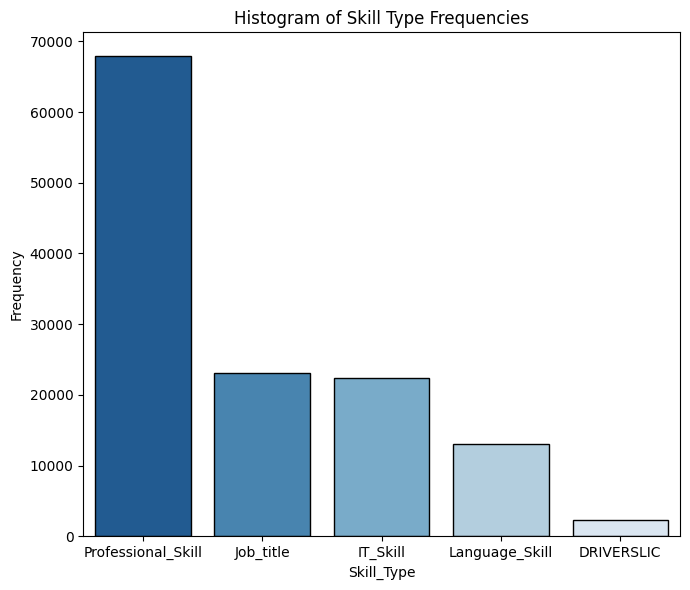
The bar chart displays the total number of skills extracted for each skill_type:

  • Professional_Skill: ~68,000 occurrences — the most frequently identified category.
  • Job_title: ~23,000 occurrences.
  • IT_Skill: ~22,000 occurrences.
  • Language_Skill: ~13,000 occurrences.
  • DRIVERSLIC: ~2,500 occurrences — the least common category.
skill_counts = (
    cv_skills.group_by("Skill_Type")
    .agg(pl.count("Skill_Type").alias("count"))
    .sort("count", descending=True)
)
display(skill_counts)
shape: (5, 2)
Skill_Type count
str u32
"Professional_Skill" 67873
"Job_title" 23169
"IT_Skill" 22415
"Language_Skill" 13075
"DRIVERSLIC" 2366
plot_skills_frequency(cv_skills)

Top N Skills by Category

The plot_skills_per_category function can be used to visualize the most frequent skills within any given skill category. It:

  1. Filters the cv_skills DataFrame by the chosen skill_type.
  2. Computes the frequency of each individual skill in that category.
  3. Plots the top n skills by their occurrence count.

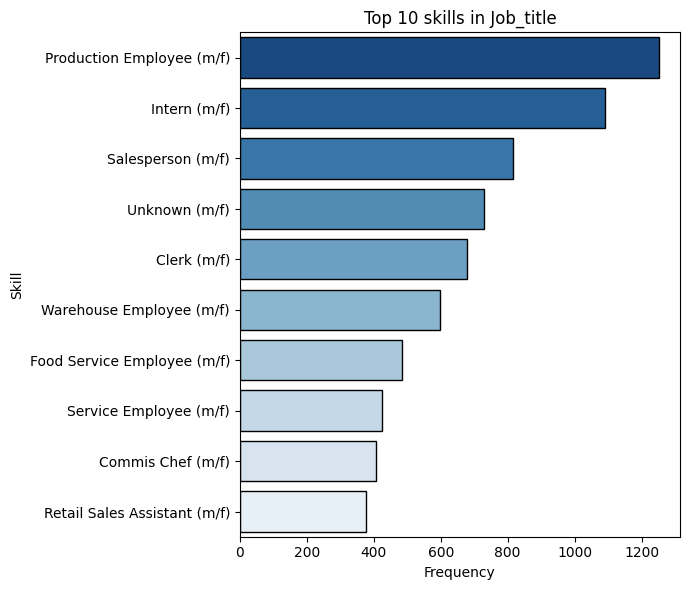
With the parameters below, we are displaying the top 10 most common skills for the Job_title category.

skill_pd = plot_skills_per_category(cv_skills, "Job_title", top_n=10)

Top N Skills for a Given Job Title

This function shows the most common <skills> for candidates who have a specific <job_title>. It simply:

  1. Picks out all candidates with the chosen job title.
  2. Collects their skills of the specified category.
  3. Counts how often each skill appears.
  4. Plots the top n skills by frequency.

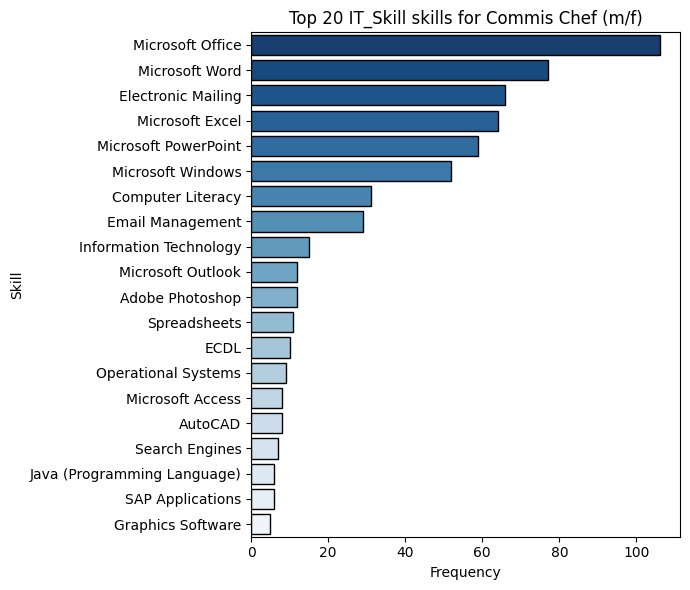
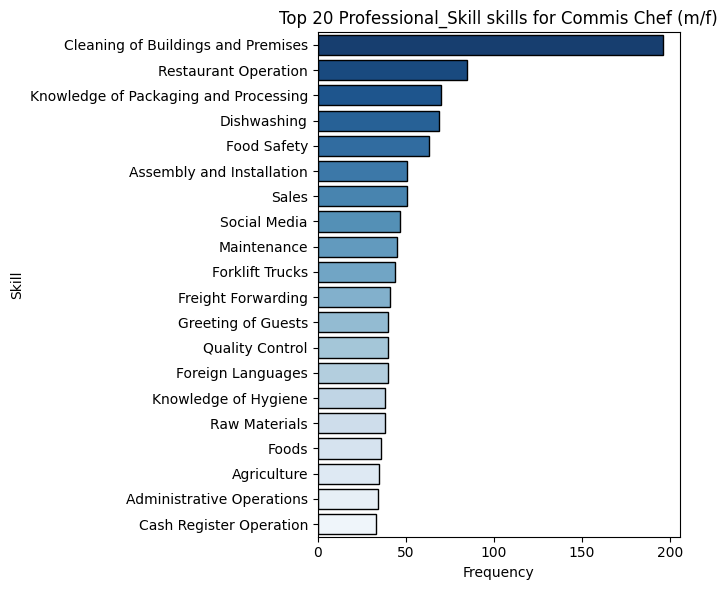
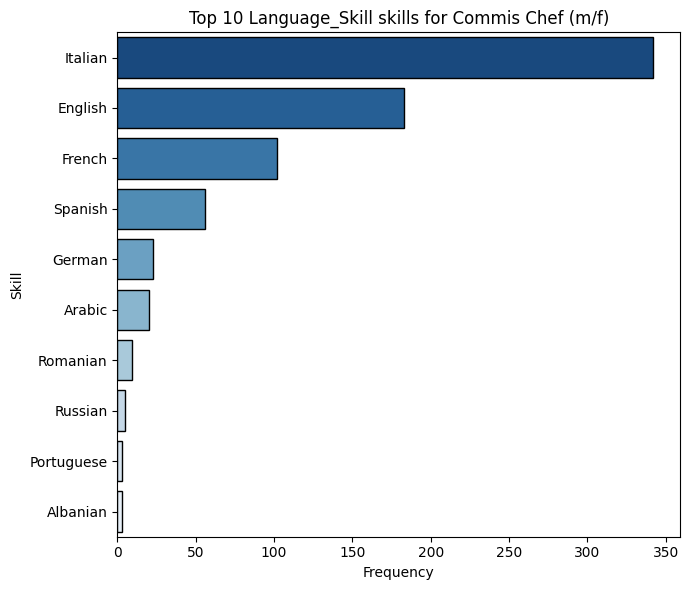
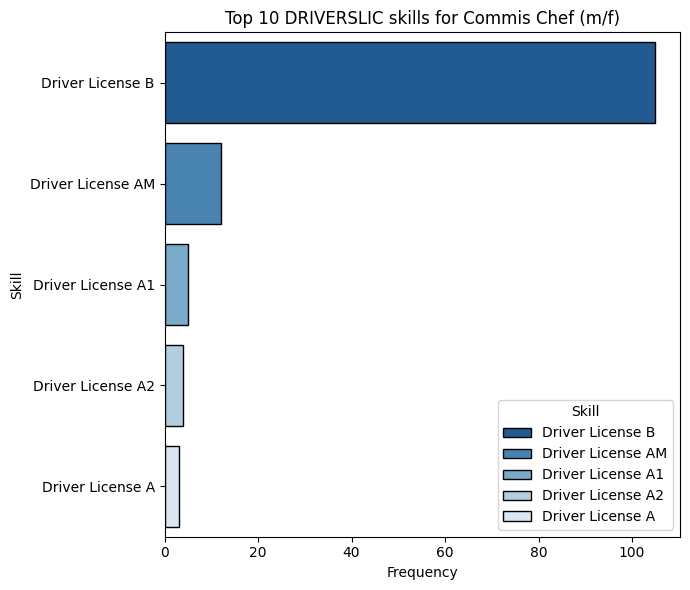
With the parameters below, we are displaying the top 20 most frequent IT skills among candidates with “Commis Chef (m/f)” job experience.

plot_top_skills_for_job_title(cv_skills, "Commis Chef (m/f)", "IT_Skill", top_n=20)

plot_top_skills_for_job_title(
    cv_skills, "Commis Chef (m/f)", "Professional_Skill", top_n=20
)

plot_top_skills_for_job_title(
    cv_skills, "Commis Chef (m/f)", "Language_Skill", top_n=10
)

plot_top_skills_for_job_title(cv_skills, "Commis Chef (m/f)", "DRIVERSLIC", top_n=10)

Counting Skills per Candidate

In this step, we aim to:

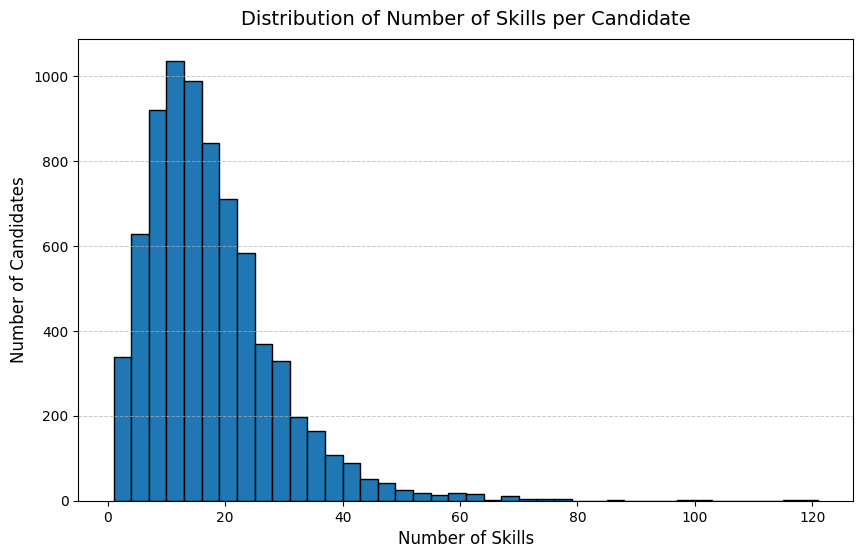
  • Visualize the distribution of the number of skills extracted per candidate.
  • Spot and investigate outliers, candidates who list an unusually high number of skills.
skill_counts = cv_skills.group_by("CANDIDATE_ID").len()

fig, ax = plt.subplots(figsize=(10, 6))
ax.hist(skill_counts["len"], bins=40, edgecolor="black")
ax.set_title("Distribution of Number of Skills per Candidate", fontsize=14, pad=10)
ax.set_xlabel("Number of Skills", fontsize=12)
ax.set_ylabel("Number of Candidates", fontsize=12)
ax.grid(axis="y", linestyle="--", linewidth=0.7, alpha=0.7)

plot_boxplot(
    data=skill_counts["len"],
    labels=None,
    title="Boxplot of Skills per Candidate",
    xlabel="Number of Skills",
    colors=["orange"],
    figsize=(10, 2),
)

Hard vs Soft Skills Analysis

In this section, we investigate the distribution of hard and soft skills extracted from the candidate CVs. (column Professional_Skill)

The logic used to label each skill as hard or soft is documented in the hard_soft_labelling.ipynb notebook.

Here we present:

  • Total distribution of hard vs soft skills across all candidates.
  • Distribution per candidate: number of hard vs soft skills per individual, to highlight representation gaps.
hard_soft_skills = load_data(HARD_SOFT_SKILLS)
display(hard_soft_skills)
shape: (2_827, 2)
Skill label
str str
"V-Ray" "Hard"
"Demographics" "Hard"
"Angel Investing" "Hard"
"Confined Spaces" "Hard"
"Target Market Selection" "Unknown"
"Emergency Management" "Soft"
"Search Engine Optimization" "Hard"
"Personal Branding" "Soft"
"Health Products" "Hard"
"Legal Consultancy" "Hard"
cv_skills_with_label = cv_skills.join(hard_soft_skills, on="Skill")
cv_skills_with_label
shape: (67_873, 4)
CANDIDATE_ID Skill Skill_Type label
i64 str str str
7974050 "Billing Processes" "Professional_Skill" "Hard"
7974050 "Databases" "Professional_Skill" "Hard"
7974050 "Polling" "Professional_Skill" "Hard"
7965670 "Accounting" "Professional_Skill" "Hard"
7965670 "Administrative Operations" "Professional_Skill" "Soft"
18233 "Knowledge of Finance" "Professional_Skill" "Hard"
18233 "Maintenance" "Professional_Skill" "Hard"
18233 "Multi-Level Marketing" "Professional_Skill" "Unknown"
18233 "Sales" "Professional_Skill" "Soft"
18233 "Telecommunications" "Professional_Skill" "Hard"
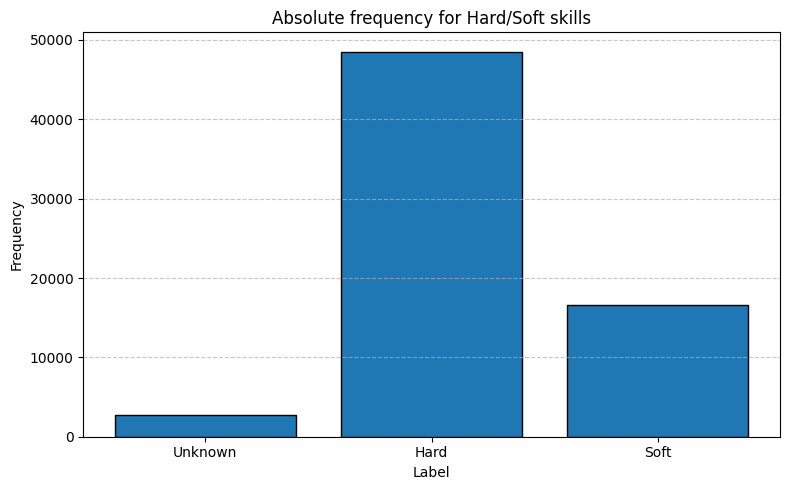
  • Hard skills dominate the dataset, accounting for roughly ~75% of all skills extracted from the CVs.

  • Soft skills are markedly under represented, at about one skill in five.

Small remainder: we classified as “Unknown” terms that did not match either taxonomy, highlighting the presence of noise in the parsed skills data. (see hard_soft_labelling.ipynb)

counts = cv_skills_with_label["label"].value_counts()
plot_distribution_bar(
    counts,
    "label",
    "count",
    "Label",
    "Frequency",
    "Absolute frequency for Hard/Soft skills",
)

per_cand = (
    cv_skills_with_label.group_by(["CANDIDATE_ID", "label"])
    .agg(pl.len())
    .pivot(
        index="CANDIDATE_ID",
        on="label",
        values="len",
    )
    .fill_null(0)
    .with_columns(
        [
            (pl.col("Hard") + pl.col("Soft") + pl.col("Unknown").fill_null(0)).alias(
                "total"
            ),
        ]
    )
)

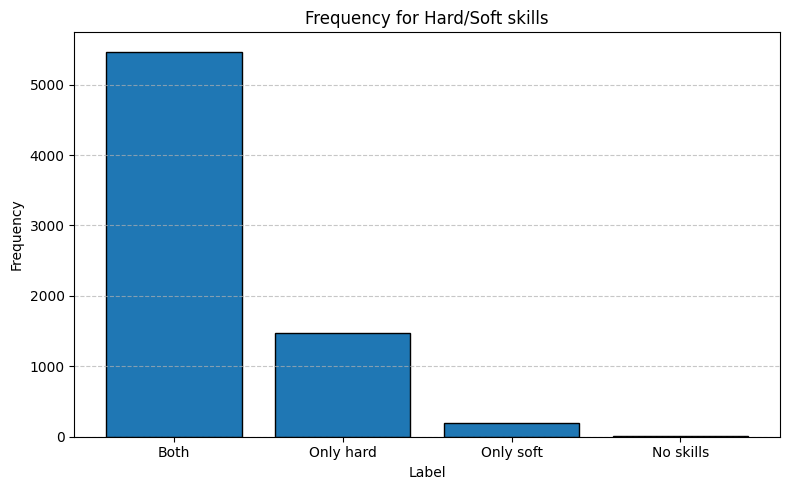
As we can see from the analysis below:

  • Most applicants (about two thirds) mention at least one hard and one soft skill, suggesting reasonably balanced self presentation.

  • One third list exclusively hard skills; they highlight only technical competence.

  • Soft skill only CVs are extremely rare; almost nobody relies on soft skills without pairing them with technical ones.

A negligible fraction provide no skills at all, indicating either very short resumes or parsing errors that deserve inspection.

cats = per_cand.with_columns(
    [
        pl.when((pl.col("Hard") == 0) & (pl.col("Soft") == 0))
        .then(pl.lit("No skills"))
        .when((pl.col("Hard") > 0) & (pl.col("Soft") == 0))
        .then(pl.lit("Only hard"))
        .when((pl.col("Hard") == 0) & (pl.col("Soft") > 0))
        .then(pl.lit("Only soft"))
        .otherwise(pl.lit("Both"))
        .alias("category")
    ]
)

counts = cats.group_by("category").len().sort("len", descending=True)

plot_distribution_bar(
    counts, "category", "len", "Label", "Frequency", "Frequency for Hard/Soft skills"
)

per_cand = per_cand.with_columns(
    (pl.col("Hard") / pl.col("total")).alias("hard_share"),
)
per_cand
shape: (7_149, 6)
CANDIDATE_ID Soft Unknown Hard total hard_share
i64 u32 u32 u32 u32 f64
136810 2 1 9 12 0.75
3977219 7 2 15 24 0.625
6763122 1 0 4 5 0.8
6829028 2 2 17 21 0.809524
6606921 4 1 6 11 0.545455
5783260 0 0 6 6 1.0
5768159 0 0 1 1 1.0
6784314 2 0 0 2 0.0
6176014 0 0 1 1 1.0
5547718 0 0 1 1 1.0

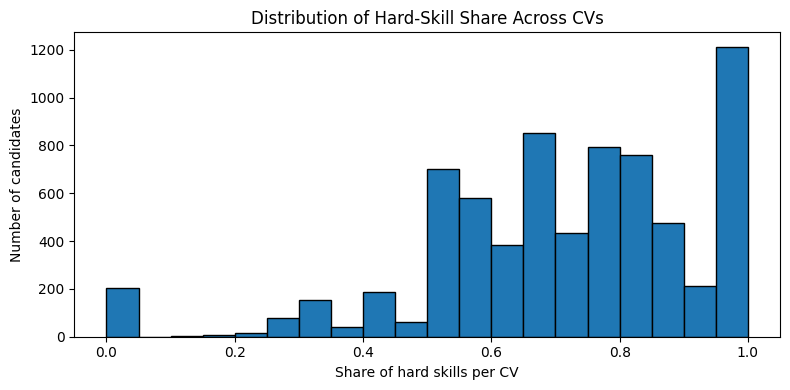
The chart shows how technical competences (hard skills) are distributed across each candidate.

For each one of them we calculate the hard skill share, the ratio between the number of hard skills and the total number of skills, listed (hard + soft + any unknown items) and we plot all of these percentages in a histogram.

data = per_cand["hard_share"].to_numpy()

plt.figure(figsize=(8, 4))
plt.hist(data, bins=20, edgecolor="black")
plt.xlabel("Share of hard skills per CV")
plt.ylabel("Number of candidates")
plt.title("Distribution of Hard-Skill Share Across CVs")
plt.tight_layout()
plt.show()

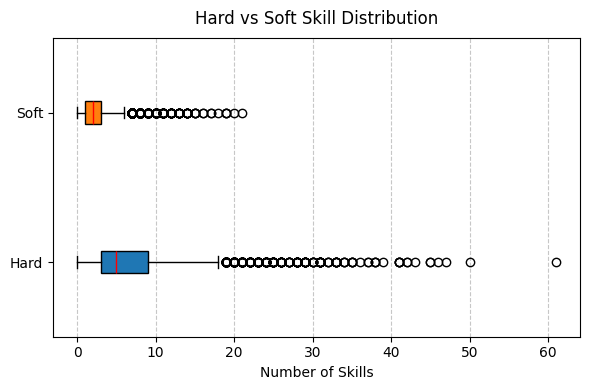
The box plot highlights several outliers. (20+ hard skills / 10+ soft skills)

Such counts are well beyond the typical range and may indicate parsing errors (e.g bullet points misclassified as skills, the same skill split into multiple tokens ecc). These outliers should be reviewed manually to confirm whether they reflect unusually rich profiles or artefacts produced by the parsing pipeline.

plot_boxplot(
    data=[per_cand["Hard"], per_cand["Soft"]],
    labels=["Hard", "Soft"],
    title="Hard vs Soft Skill Distribution",
    xlabel="Number of Skills",
    colors=["#1f77b4", "#ff7f0e"],
    figsize=(6, 4),
)