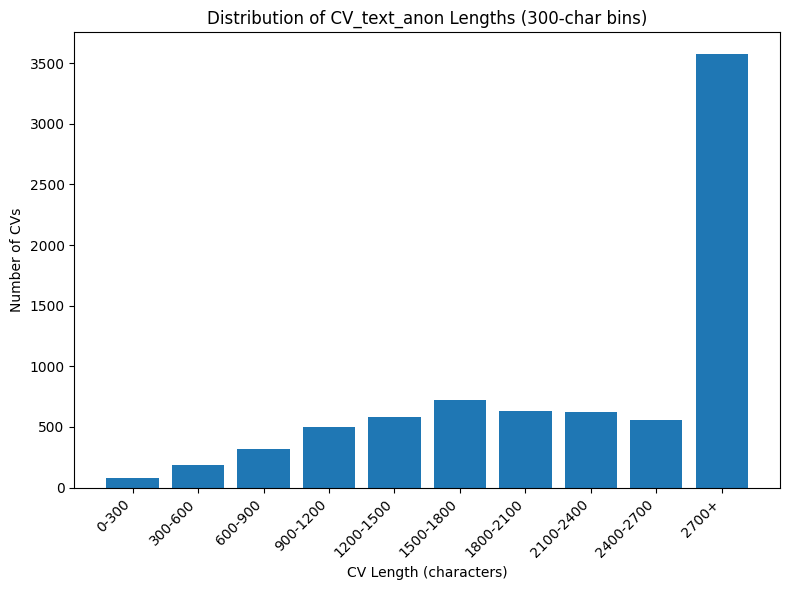
Found 77 CVs with CV_text_anon < 300 chars. Showing up to 10:
 1. ID 7560889: 263 chars
 2. ID 7456101: 29 chars
 3. ID 7437776: 279 chars
 4. ID 7414638: 110 chars
 5. ID 7373536: 58 chars
 6. ID 7364629: 202 chars
 7. ID 7347338: 82 chars
 8. ID 7330315: 237 chars
 9. ID 7230306: 238 chars
 10. ID 7163148: 253 chars

Example full CV for ID 5475487:
'CV anonimizzato:\n"""\n03/2006 - 01/2010\n02/1995 - 01/2006\n04/1987 - 01/1995\n10/1981 - 01/1987Autorizzo il trattamento dei miei dati personali presenti nel curriculum vitae ai sensi del Decreto Legislativo 30 giugno 2003, n. 196 e del GDPR (Regolamento UE 2016/679).\n"""'
CVs with under 300 characters: 77 out of 7769 total
That is 0.99% of all cvs
CVs -> Original rows: 7769
CVs -> Dropped rows:  77 (IDs in provided list)
CVs -> Remaining rows: 7692
CVs with repetitive CVs: 39 out of 7692 total
That is 0.51% of all cvs
CVs -> Original rows: 7692
CVs -> Dropped rows:  39 (IDs in provided list)
CVs -> Remaining rows: 7653
4. Text Quality Checks
Furthermore we filter out “bad” or malformed CVs, for doing that we will perform:
Token & Vocabulary Richness
Calculate the unique words / total words ratio to measure lexical variety.
Filter out CVs with very low number of unique words (e.g < 20) or very low ratio (e.g. < 0.2).
Detect Placeholder Tails
Flag any CV whose text ends with a long run of the same character (e.g. “XXXXXXXXXX…”), seen after manual inspection. These indicate no usable content and should be excluded.
Detect Corrupted CVs
Compute the fraction of “unusual” characters in each CV. Flag and remove any CV where this fraction exceeds a small threshold (e.g. 3%), catching heavily distorted documents.
These additional checks will help us catch CVs that are too short, overly repetitive, or structurally invalid.
Token & Vocabulary Richness
sparse_cvs = detect_vocab_sparsity( raw_cv_cleaned, text_col="CV_text_anon", min_words=30, min_ttr=0.3)print(f"CVs to discard based on vocabulary sparsity: {sparse_cvs.height}")display( sparse_cvs.select(["CANDIDATE_ID", "total_words", "unique_words", "ttr"]).sort( pl.col("ttr"), descending=False ))
CVs with low lexical variety: 48 out of 7653 total
That is 0.63% of all cvs
CVs -> Original rows: 7653
CVs -> Dropped rows:  48 (IDs in provided list)
CVs -> Remaining rows: 7605
Detect Placeholder Tails
placeholder_cvs = filter_placeholder_tails( raw_cv_cleaned, text_col="CV_text_anon", char="X", min_run=20)print(f"Found {placeholder_cvs.height} CVs with trailing X placeholders:")display(placeholder_cvs.select(["CANDIDATE_ID"]))
CVs with trailing X placeholders: 52 out of 7605 total
That is 0.68% of all cvs
CVs -> Original rows: 7605
CVs -> Dropped rows:  52 (IDs in provided list)
CVs -> Remaining rows: 7553
CVs with corrupted symbols: 14 out of 7553 total
That is 0.19% of all cvs
CVs -> Original rows: 7553
CVs -> Dropped rows:  14 (IDs in provided list)
CVs -> Remaining rows: 7539
5. Translation Completeness
Filter Out Poor Translations
Compute len_ratio = len(Translated_CV) / len(CV_text_anon) and flag any CV with len_ratio < 0.7 as an empty/missing translation.
Since these cases are very rare, we drop them outright instead of attempting a re-translation.
CVs with low translation completeness: 18 out of 7539 total
That is 0.24% of all cvs
CVs -> Original rows: 7539
CVs -> Dropped rows:  18 (IDs in provided list)
CVs -> Remaining rows: 7521
Since our analysis relies exclusively on the English translations, we will now verify that the Translated_CV column truly contains English text before proceeding with our analyses.
not_english_df = ( raw_cv_cleaned.with_columns( [ pl.col("Translated_CV") .map_elements(lambda s: not is_this_language(s or"", "en"), return_dtype=pl.Boolean, ) .alias("not_english") ] ) .select(["CANDIDATE_ID", "Translated_CV", "not_english"]) .filter(pl.col("not_english")))print(f"Found {not_english_df.height} CVs not in English.")display(not_english_df.head())
Found 16 CVs not in English.
shape: (5, 3)
CANDIDATE_ID
Translated_CV
not_english
i64
str
bool
7546519
" gender male birthdate 18/10/1…
true
7292989
" work experience 10/15/2015 – …
true
7282933
" f o r m a t o e u r o p e o p…
true
7130948
" professional experience ener …
true
6871809
" experience bartender/barista …
true
print("Sample CVs not in English:")print(not_english_df.sample(1)["Translated_CV"].item())
Sample CVs not in English:
work experience 10/15/2015 – 01/18/2016 Vercelli, Italy Hertz mechanic 1. tire fitter 2. coupons address via fagiolini 11, 13100, Vercelli, Italy 09/01/2016 – 12/01/2016 Vercelli, Italy Hertz mechanic 1. tire fitter date of birth: 09/09/1995 2. coupons nationality: Italian address via fagiolini 11, 13100, Vercelli, Italy gender: male 04/02/2017 – 05/31/2017 Crescentino, Italy tire fitter Pneuscar sas di Mauro d'Altoè e c. contacts 1. tire dealer address via giotto 54, 13044, crescentino, italy via umberto i 22 27030 palestro, italy (other) 01/07/2017 – 15/06/2018 saluggia, italy manuelboni31@gmail.com electrician electrician momo massimo (+39) 3515326965 1. electrician 2. removal worker address via taiola, 13040, saluggia, italy 22/10/2018 – 07/12/2018 crescentino, italy tire dealer pneuscar sas di mauro d'altoè e c. 1. tire dealer address via giotto 54, 13044, crescentino, italy 04/19/2019 – 06/15/2019 crescentino, italy tire dealer pneuscar sas di mauro d'altoè e c. 1. tire dealer address via giotto 54, 13044, crescentino, italy 07/14/2020 – 10/18/2022 desana, italy blacksmith il ferraccio di balbo fabrizio 1. metalworker 2. maintenance and repairer of agricultural vehicles at "claas agricoltura vercelli" address via gioberti 64, 13034, desana, italy 10/19/2022 – 12/31/2022 vercelli, italy worker ecam srl 1. worker 2. assistant mechanical repairer of trucks 1 / 23. blacksmith address via f. donato 11/a, 13100, vercelli, italy education and training 09/2006 – 06/2012 vercelli, italy middle school diploma state school of first degree "l. verga" address via trino 32, vercelli, italy language skills native language: italian additional information driving license 05/25/2015 – 09/09/2025 driving license: b I authorize the processing of my personal data in the CV pursuant to art. 13 legislative decree 30 June 2003 n. 196 - "personal data protection code" and art. 13 gdpr 679/16 - "european regulation on the protection of personal data". 2 / 2
We found only 16 records flagged as non-English. After a manual review, we discovered that these CVs are indeed written in English but include many Italian place names, addresses and organization titles which skew the language detector’s statistics. Since the underlying text is English and these cases are few, we will not drop them.
Note: going forward, all regex or pattern-based quality checks should be applied only to the EnglishTranslated_CV field.
6. Handling Empty CV Records
During our inspection we found many corrupted CVs. In each dedicated section, to ensure data quality and consistency across all our analyses, we will:
Exclude their parsed skills
Filter out any rows in our parsed skills DataFrame (cv_skills) corresponding to those same CANDIDATE_IDs.
Omit their entries in the Reverse Matching results
Drop records in the Reverse Matching dataset (ReverseMatching.xlsx) for those candidate IDs.
Exclude parsed skills of the candidates with corrupted CVs.
raw_cv_ids = raw_cv.select(pl.col("CANDIDATE_ID")).to_series().to_list()print("Number of CVs loaded ->", len(raw_cv_ids))raw_cv_cleaned_ids = raw_cv_cleaned.select(pl.col("CANDIDATE_ID")).to_series().to_list()print("Number of CVs kept after cleaning ->",len(raw_cv_cleaned_ids),)raw_cv_deleted_ids = ( raw_cv.filter(~pl.col("CANDIDATE_ID").is_in(raw_cv_cleaned_ids)) .select(pl.col("CANDIDATE_ID")) .to_series() .to_list())print("Number of CVs deleted ->",len(raw_cv_deleted_ids),)
Number of CVs loaded -> 7769
Number of CVs kept after cleaning -> 7521
Number of CVs deleted -> 248
raw_skills_cleaned = filter_out_candidate_ids( raw_skills, raw_cv_deleted_ids, df_name="Skills", description="CVs deleted")################### Sanity check on the new number of unique candidate IDs.total_rows = raw_skills_cleaned.heightunique_ids = raw_skills_cleaned.select(pl.col("CANDIDATE_ID")).unique().heightprint(f"Unique CANDIDATE_ID: {unique_ids}")
Skills with CVs deleted: 4086 out of 132985 total
That is 3.07% of all skills
Skills -> Original rows: 132985
Skills -> Dropped rows:  4086 (IDs in provided list)
Skills -> Remaining rows: 128899
Unique CANDIDATE_ID: 7521
2. Missing Value Inspection
inspect_missing(raw_skills_cleaned)
Missing value summary:
shape: (3, 3)
column
n_missing
pct_missing
str
u32
f64
"CANDIDATE_ID"
0
0.0
"Skill"
82
0.06
"Skill_Type"
0
0.0
Columns with > 0% missing values:
shape: (1, 3)
column
n_missing
pct_missing
str
u32
f64
"Skill"
82
0.06
Inspecting missing values we’ve found that 82 rows are missing a Skill value. Diving into the data, we see that these rows are all associated with the value DRIVERSLIC in the Skill_Type column. This indicates that these rows are likely placeholders for driver license information, which is however useful to our analysis. We will not drop these rows from the dataset.
Total rows: 128898
Unique (ID, Skill, Skill_Type): 128898
No duplicates found, skipping deduplication.
4. Validate Skill Types
Ensure Skill_Type only takes one of your known categories (IT_Skill, Job_title, Language_Skill, Professional_Skill, DRIVERSLIC).
VALID_TYPES = ["IT_Skill","Job_title","Language_Skill","Professional_Skill","DRIVERSLIC",]all_types = raw_skills_cleaned.select("Skill_Type").unique().to_series().to_list()invalid_types = [t for t in all_types if t notin VALID_TYPES]##############if invalid_types:print("Found invalid Skill_Type values:")for t in invalid_types:print(" -", t)else:print("All Skill_Type values are valid.")
All Skill_Type values are valid.
5. Filter Out Garbage Skill Tokens
Drop any Skill entries that are obviously malformed (e.g. length < 2 or > 100, only punctuation or digits).
Optionally remove entries matching placeholder patterns (like a long run of X).
reversed_skills_matching = filter_out_candidate_ids( reversed_skills_matching, raw_cv_deleted_ids, df_name="Reverse Matchhing Candidates", description="CVs deleted",)################### Sanity check on the new number of unique candidate IDs.total_rows = reversed_skills_matching.heightunique_ids = reversed_skills_matching.select(pl.col("CANDIDATE_ID")).unique().heightprint(f"Unique CANDIDATE_ID: {unique_ids}")
Reverse Matchhing Candidates with CVs deleted: 248 out of 7769 total
That is 3.19% of all reverse matchhing candidates
Reverse Matchhing Candidates -> Original rows: 7769
Reverse Matchhing Candidates -> Dropped rows:  248 (IDs in provided list)
Reverse Matchhing Candidates -> Remaining rows: 7521
Unique CANDIDATE_ID: 7521
2. Missing Value Inspection
inspect_missing(reversed_skills_matching)
Missing value summary:
shape: (12, 3)
column
n_missing
pct_missing
str
u32
f64
"CANDIDATE_ID"
0
0.0
"Gender"
0
0.0
"Age_bucket"
0
0.0
"professional_categories_int"
7
0.09
"matterknowledges"
3818
50.76
…
…
…
"candidatecity"
0
0.0
"drivinglicenses"
3586
47.68
"LONGITUDE"
0
0.0
"LATITUDE"
0
0.0
"experience"
2
0.03
Columns with > 0% missing values:
shape: (6, 3)
column
n_missing
pct_missing
str
u32
f64
"professional_categories_int"
7
0.09
"matterknowledges"
3818
50.76
"languages"
4011
53.33
"regulatedtrainings"
4143
55.09
"drivinglicenses"
3586
47.68
"experience"
2
0.03
3. Analyze demographic data
Next, we examine the demographic columns (age, gender, and location) to spot correlations and identify any redundant fields.
After classifying candidates as North, Center, or South by latitude, we select the columns of interest and examine their inter-correlations to decide which ones to analyze next.
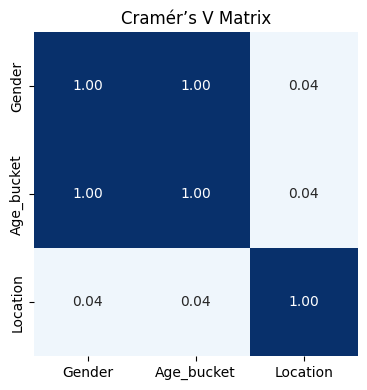
To find inter correlations, we compute a square matrix whose (i, j) entry is the Cramér’s V between column i and column j in reversed_skills_matching. (computed with polars‑ds)
It normalises the χ² test of independence to the range [0, 1]:
\[
V \;=\; \sqrt{\frac{\chi^{2}}{\,n\bigl(k_{\min}-1\bigr)}}
\]
where
χ² is the chi-square statistic,
n is the number of rows,
\(k_{\min}\) is the smaller of the two variables’ unique value counts.
Thus V = 0 means no association, V = 1 means a perfect link.
Attention!
The heat-map reveals a striking finding: Age Bucket and Gender are perfectly correlated (Cramér’s V = 1.0).
Since either variable fully determines the other, we will keep only one in subsequent analyses to avoid redundancy.
plot_cramer_matrix(cramer_matrix)
The tables below makes this explicit: every female candidate is aged 55 – 74, while every male candidate is aged 25 – 34.